Commercial data cabling in Nashville, TN
Commercial Data Cabling Installation in Nashville
Build the physical connections your facility needs with clearly planned cable routes, clean terminations, organized rack-side work, consistent labels, and testing defined for the project.
Infrastructure scope
Data drops built around the space and the scope
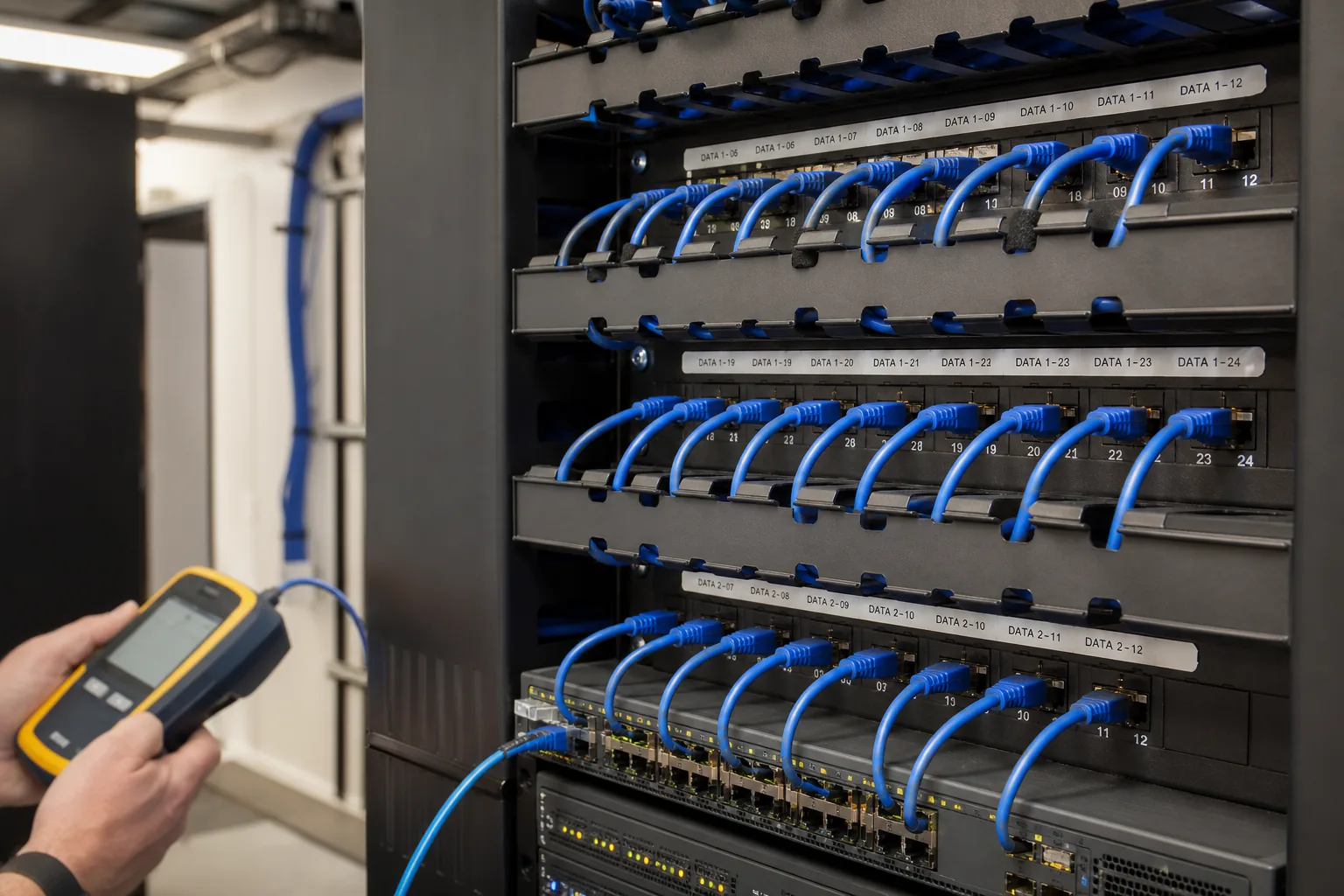
Commercial data cabling connects work areas, phones, printers, access points, cameras, controls, and other networked devices back to the telecommunications room. The cable category is important, but the pathway, distance, termination hardware, rack capacity, labeling plan, and test requirement also shape a dependable installation.
Nashville Data Cabling can scope a single expansion, a full tenant buildout, or remediation of existing wiring. Active electronics and network administration stay secondary; the permanent physical layer is the core work.
- Cat6 and Cat6A horizontal cabling
- Work-area jacks, faceplates, and device drops
- Patch-panel and rack-side termination
- J-hooks, supports, sleeves, and pathway coordination
- Port, cable, and outlet labels
- Testing and closeout records when specified
Plan the physical layer
What should a data cabling proposal define?
A useful proposal describes more than a drop count. It states what is being connected, where each run begins and ends, how it will be supported, and what the handoff includes.
01
Cable and components
Select the cable category, jacks, patch panels, rack hardware, and pathway materials around the project requirement and environment.
02
Routes and access
Confirm cable distances, ceiling conditions, sleeves, rated assemblies, lifts, work hours, escorts, and areas that must remain operational.
03
Labels and testing
Agree on the naming convention, test method, acceptance criteria, report format, and any drawings or port schedules required at closeout.
Straightforward project flow
From scope review to tested handoff
A clear cabling project starts with the building conditions and ends with the agreed documentation.
1
Share the project
Send the address, drawings, drop list, photos, schedule, and known site restrictions.
2
Review conditions
We review pathways, distances, network spaces, access, construction phase, and active-service constraints.
3
Define the scope
The proposal identifies included cabling, hardware, assumptions, responsibilities, testing, and closeout.
4
Install and hand off
Work is coordinated, labeled, tested to the agreed requirement, and closed out with defined records.
Common questions
Data cabling questions
Plain answers about scope, materials, testing, and project coordination.
A project can include copper cable runs, supports and pathways, jacks, faceplates, patch panels, rack-side termination, cable management, labels, testing, and closeout records. The exact items are listed in the proposal.
Cat6 and Cat6A differ in construction, supported channel performance, diameter, pathway use, and installation requirements. The right choice depends on the specification, cable distance, connected application, environment, and future plans.
Yes. Existing-site work is planned around access, ceiling conditions, active operations, work windows, device locations, pathway limits, and the network-room condition.
The proposal should define the test method. Basic verification confirms wiring and connectivity; certification evaluates an installed link against an agreed cabling performance limit and can provide electronic reports.
Need data cabling for a Nashville project?
Send the address, drawings or drop list, approximate quantities, construction phase, and target schedule. Clear photos of the existing rack also help.
Commercial data cabling, network wiring, structured copper, fiber, racks, testing, cleanup, and construction cabling for Nashville-area facilities.
[COMPANY_LEGAL_NAME]
[LICENSE]
Site Links
© 2026 Nashville Data Cabling. All rights reserved.
Physical cabling infrastructure. Clear scope. Tested handoff.