Network wiring for commercial facilities
Commercial Network Wiring in Nashville, TN
Add, relocate, replace, or organize the permanent wiring that connects business devices to the network room without turning the scope into a broad managed-IT project.
Infrastructure scope
Network wiring for expansions, moves, and facility changes
Network wiring projects often begin with a practical need: new desks, relocated equipment, a warehouse expansion, additional device locations, a remodeled suite, or an inherited rack that no longer matches the floor. The work starts by tracing the physical route and confirming where the cable will terminate.
We focus on permanent low-voltage infrastructure. Switch configuration, cybersecurity, software, and ongoing network administration are not the primary offer; wiring, pathways, terminations, racks, and testing are.
- New network outlets and device drops
- Moves, adds, changes, and relocations
- Office, warehouse, retail, and facility wiring
- Rack and patch-panel connections
- Cable identification and port mapping
- Replacement of damaged or unsuitable runs
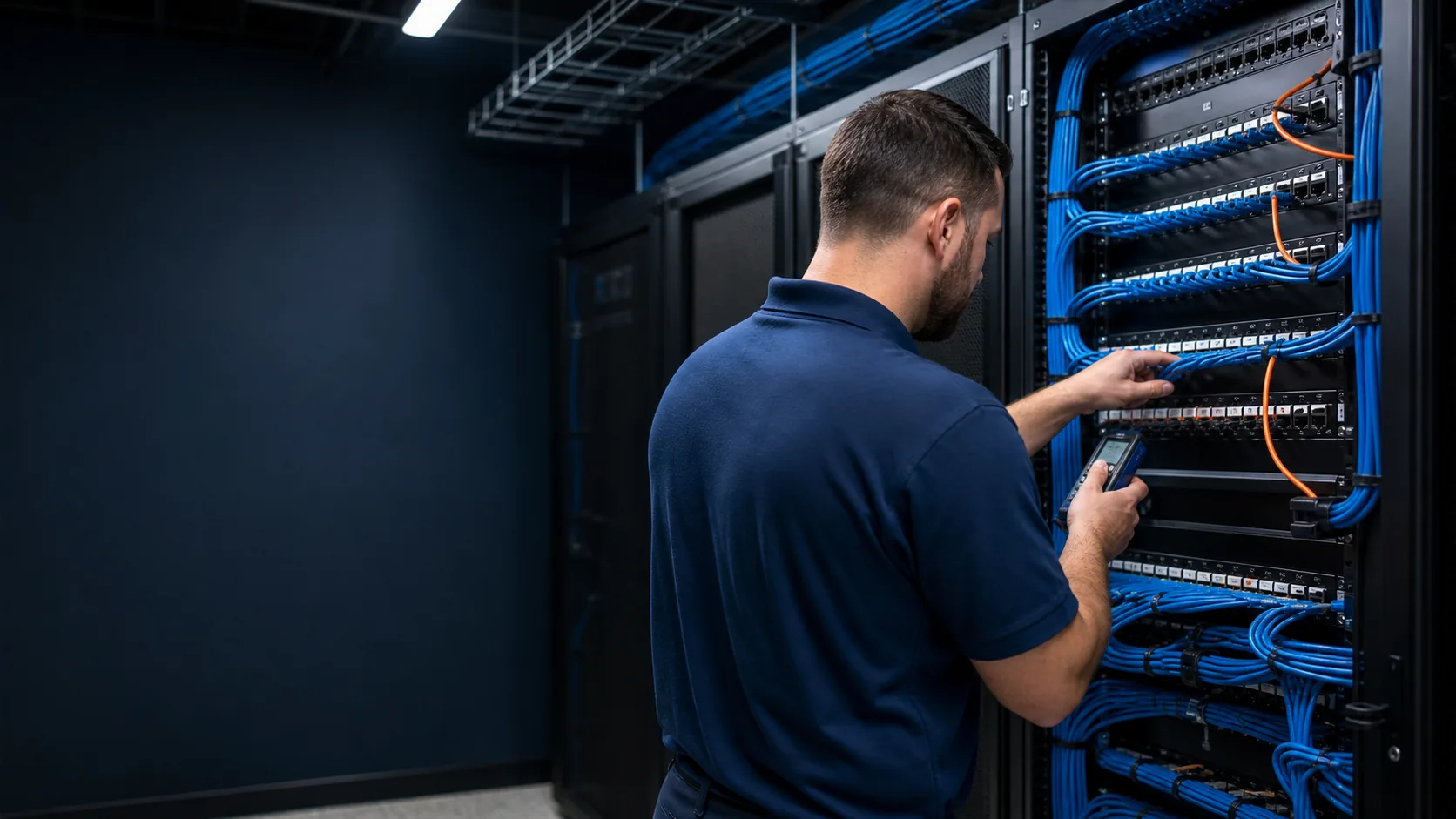
Plan the physical layer
Plan the route before pulling cable
A device location is only one end of the job. The path back to the network space has to fit distance limits, building access, supports, penetrations, and existing operations.
01
Device locations
Mark outlet, phone, printer, access-point, camera, controller, and other connected-device positions on a drawing or floor plan.
02
Network room
Confirm rack location, available patch-panel space, grounding and power by others, cable entry, patching responsibilities, and labeling.
03
Work conditions
Document occupied areas, ceiling type, lift needs, restricted spaces, after-hours windows, construction milestones, and interruption limits.
Straightforward project flow
From scope review to tested handoff
A clear cabling project starts with the building conditions and ends with the agreed documentation.
1
Share the project
Send the address, drawings, drop list, photos, schedule, and known site restrictions.
2
Review conditions
We review pathways, distances, network spaces, access, construction phase, and active-service constraints.
3
Define the scope
The proposal identifies included cabling, hardware, assumptions, responsibilities, testing, and closeout.
4
Install and hand off
Work is coordinated, labeled, tested to the agreed requirement, and closed out with defined records.
Common questions
Network wiring questions
Plain answers about scope, materials, testing, and project coordination.
Network wiring is the physical cable, jacks, patch panels, racks, and pathways. Network support generally covers active equipment, configuration, software, users, and troubleshooting. This site focuses on the physical infrastructure.
Small additions can be evaluated along with larger buildouts. The quote depends on route access, distance, termination location, site rules, and whether existing hardware has capacity.
Warehouse work can include office drops, access-point cabling, equipment-area connections, long routes, elevated locations, and fiber links. Lift access and active-operation rules need to be included in the scope.
Existing cabling should be identified and tested before reuse. Labels, visible condition, cable category, route, termination quality, and test results help determine whether a run fits the new requirement.
Planning network wiring changes?
Share the device locations, network-room photos, building conditions, and schedule. We will identify the details needed to define the physical wiring scope.
Commercial data cabling, network wiring, structured copper, fiber, racks, testing, cleanup, and construction cabling for Nashville-area facilities.
[COMPANY_LEGAL_NAME]
[LICENSE]
Site Links
© 2026 Nashville Data Cabling. All rights reserved.
Physical cabling infrastructure. Clear scope. Tested handoff.