Organized commercial cabling infrastructure
Structured Cabling Systems for Nashville Businesses
Create a consistent physical cabling system with planned pathways, standardized work-area outlets, centralized terminations, practical labels, and an agreed testing and closeout process.
Infrastructure scope
A structured system instead of isolated cable runs
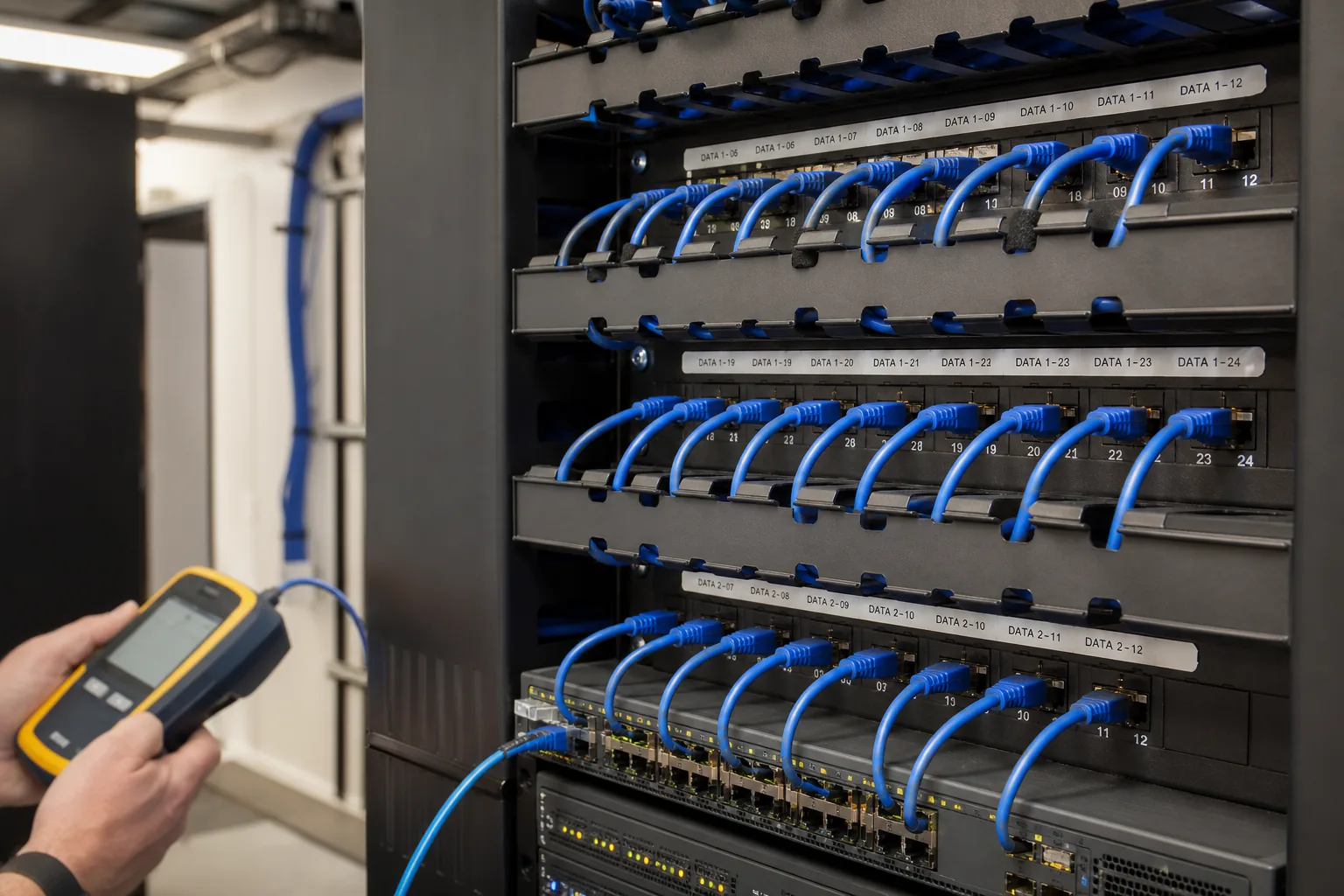
Structured cabling organizes copper and fiber into defined work areas, telecommunications spaces, backbone routes, patch panels, racks, and labeling conventions. That structure makes the physical layer easier to document, change, and maintain as the facility evolves.
The design must still match the real building. Ceiling access, rated walls, pathway capacity, cable distances, network-room space, equipment locations, and construction sequencing belong in the scope before installation begins.
- Horizontal Cat6 or Cat6A cabling
- Backbone copper or fiber as specified
- Telecommunications-room terminations
- Patch panels, racks, and cable management
- Work-area outlets and device cabling
- Naming standards, testing, and closeout
Plan the physical layer
Components of a structured cabling system
The visible jack is only one part of the system. Reliable infrastructure depends on coordinated spaces, pathways, support, hardware, labels, and documentation.
01
Work areas
Coordinate outlet quantities and locations with furniture, devices, wall construction, accessibility, and future changes.
02
Pathways and spaces
Review telecom rooms, rack capacity, sleeves, tray, supports, conduit by others, penetrations, and distance limits.
03
Administration
Use an agreed outlet, cable, panel, and port naming scheme so test records and floor plans can match the installed system.
Straightforward project flow
From scope review to tested handoff
A clear cabling project starts with the building conditions and ends with the agreed documentation.
1
Share the project
Send the address, drawings, drop list, photos, schedule, and known site restrictions.
2
Review conditions
We review pathways, distances, network spaces, access, construction phase, and active-service constraints.
3
Define the scope
The proposal identifies included cabling, hardware, assumptions, responsibilities, testing, and closeout.
4
Install and hand off
Work is coordinated, labeled, tested to the agreed requirement, and closed out with defined records.
Common questions
Structured cabling questions
Plain answers about scope, materials, testing, and project coordination.
Structured cabling is an organized system of cables, pathways, spaces, termination hardware, work-area outlets, labels, and administration practices that supports building communications and connected devices.
It can. A complete scope may include wall- or floor-mounted racks, cabinets, patch panels, horizontal and vertical cable management, grounding coordination, labels, and equipment-layout planning.
Copper or fiber infrastructure can serve many network-connected devices when cable type, power requirements, route, distance, and connected equipment are accounted for in the design.
No. It can be installed during new construction, tenant improvements, renovations, expansions, or remediation of an existing facility.
Build a cleaner cabling standard for the facility
Send the plans, device schedule, telecom-room details, specification, and required handoff format. We will review the physical infrastructure scope.
Commercial data cabling, network wiring, structured copper, fiber, racks, testing, cleanup, and construction cabling for Nashville-area facilities.
[COMPANY_LEGAL_NAME]
[LICENSE]
Site Links
© 2026 Nashville Data Cabling. All rights reserved.
Physical cabling infrastructure. Clear scope. Tested handoff.