Remediation for inherited cabling
Network Cable Management and Cleanup in Nashville
Turn crowded racks, unclear labels, unsupported bundles, damaged jacks, and legacy wiring into a documented remediation scope without guessing which cables are safe to remove.
Infrastructure scope
Identify active services before changing the rack
Cleanup work begins with investigation. Unlabeled cabling may still support an active device, life-safety interface, tenant, camera, phone, controller, or network service. Removal or relocation should follow owner authorization and a clear understanding of what must remain operational.
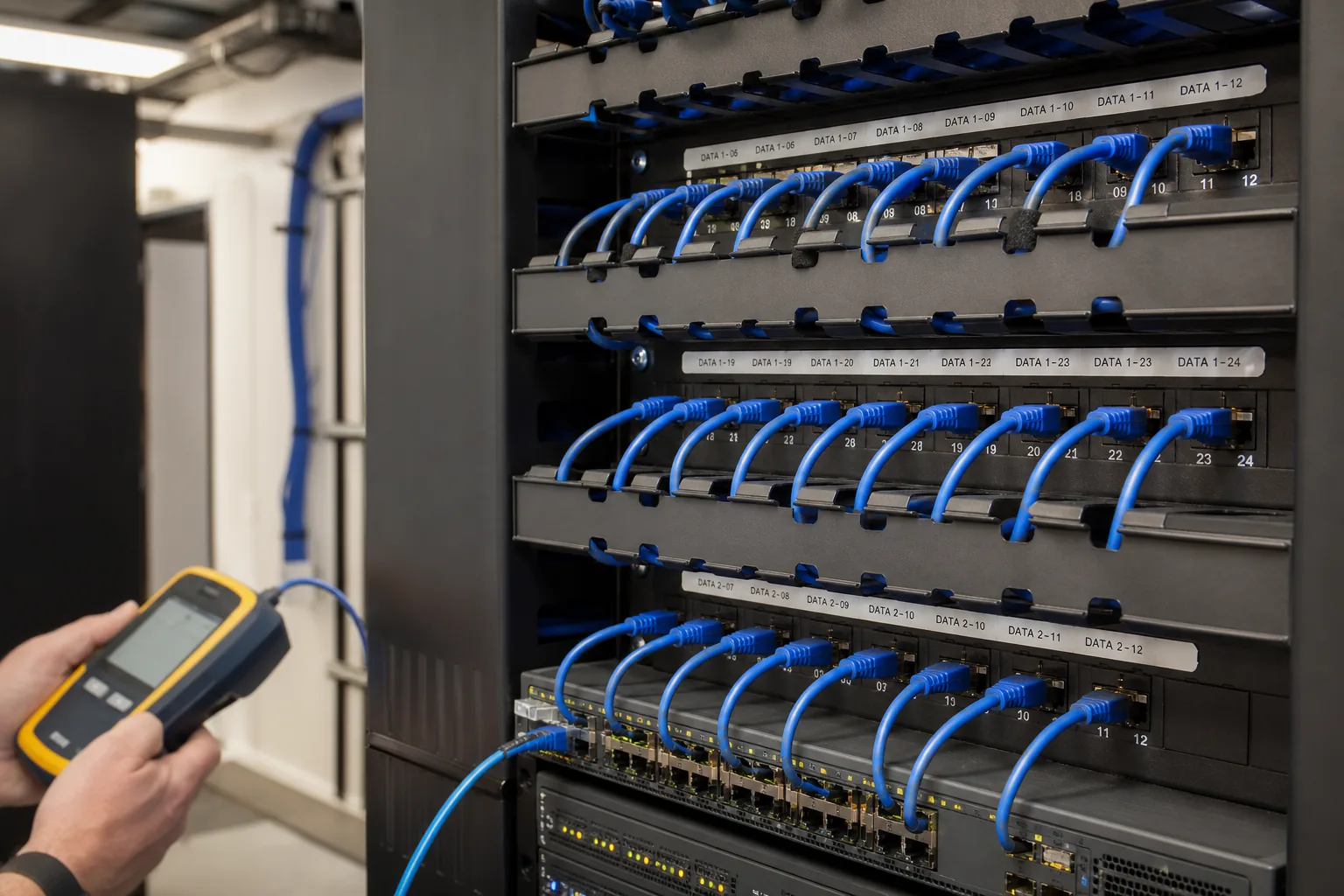
Depending on the goal, remediation can include tracing, relabeling, replacing damaged terminations, adding patch panels or managers, shortening or organizing patch cords, correcting support issues, or removing confirmed abandoned cabling where the scope and building rules allow.
- Rack and patch-panel condition review
- Cable tracing and port identification
- Patch-cord organization and replacement
- New labels and port maps
- Correction of damaged or unsupported cabling
- Authorized abandoned-cable removal
Plan the physical layer
A safe cleanup plan protects active operations
The sequence matters. Inventory, identification, authorization, work windows, rollback planning, labeling, and testing reduce the risk of disconnecting something the facility still needs.
01
Document first
Photograph the existing condition, identify panels and equipment, trace unknowns where practical, and create a working port or cable list.
02
Define the change
Separate confirmed active, spare, damaged, replacement, and authorized abandoned cabling. State who approves removals and outages.
03
Rebuild and verify
Complete the agreed changes in sequence, relabel connections, test affected cabling, update the list, and note unresolved conditions.
Straightforward project flow
From scope review to tested handoff
A clear cabling project starts with the building conditions and ends with the agreed documentation.
1
Share the project
Send the address, drawings, drop list, photos, schedule, and known site restrictions.
2
Review conditions
We review pathways, distances, network spaces, access, construction phase, and active-service constraints.
3
Define the scope
The proposal identifies included cabling, hardware, assumptions, responsibilities, testing, and closeout.
4
Install and hand off
Work is coordinated, labeled, tested to the agreed requirement, and closed out with defined records.
Common questions
Cable cleanup questions
Plain answers about scope, materials, testing, and project coordination.
Confirmed abandoned cabling can be included when the owner authorizes removal and the route, building rules, firestopping, access, and disposal responsibilities are understood. An unidentified cable should not be assumed abandoned.
Some work can be phased around active services, but tracing, moving, or replacing patch cords may still require approved windows and a rollback plan. The risk is reviewed before work begins.
It can. A remediation scope may create consistent rack, panel, port, cable, and outlet labels along with a port map or closeout list.
Yes, after the cabling and active-service conditions are reviewed. Replacement hardware, retesting, patching, and any outage coordination should be listed in the proposal.
Inherited a cabling problem?
Send wide photos of the room and pathways, close-ups of panels and labels, a description of known active services, and the cleanup goal.
Commercial data cabling, network wiring, structured copper, fiber, racks, testing, cleanup, and construction cabling for Nashville-area facilities.
[COMPANY_LEGAL_NAME]
[LICENSE]
Site Links
© 2026 Nashville Data Cabling. All rights reserved.
Physical cabling infrastructure. Clear scope. Tested handoff.