Racks, patch panels, and termination spaces
Server Room and Network Closet Cabling in Nashville
Create an organized termination point for copper and fiber with practical rack layouts, patch panels, cable management, labels, pathway entry, and room conditions coordinated with the project team.
Infrastructure scope
The network room is part of the cabling system
A clean field installation can still become difficult to maintain if the termination space is undersized, crowded, poorly labeled, or missing a deliberate cable-entry and management plan. New rooms and inherited closets both benefit from a physical review before more cabling is added.
The cabling scope can coordinate rack or cabinet placement, patch-panel capacity, cable managers, fiber enclosures, ladder rack or tray, labels, patching boundaries, and separation from electrical work. Active equipment configuration remains secondary.
- Wall-mounted and floor-mounted rack coordination
- Copper patch panels and fiber enclosures
- Horizontal and vertical cable management
- Backboard, tray, and pathway entry planning
- Rack, panel, port, and cable labels
- Existing-rack review and remediation
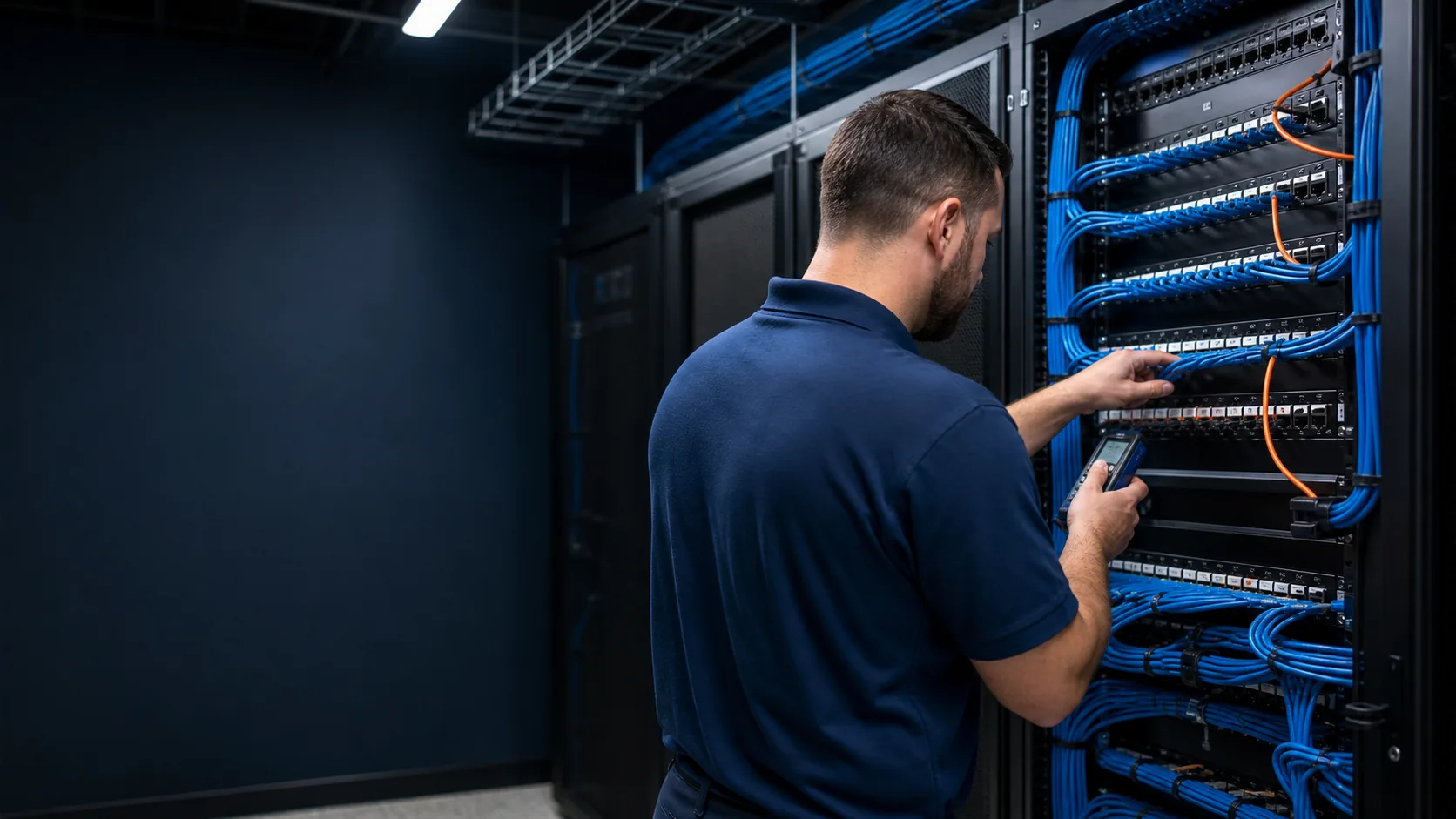
Plan the physical layer
Make the termination space usable
Capacity, access, cooling, power, grounding, pathway entry, equipment ownership, and future changes should be discussed before the rack fills up.
01
Space and access
Confirm room dimensions, door clearance, rack service access, wall condition, ceiling height, security, equipment ownership, and work windows.
02
Rack layout
Plan rack units for panels, managers, enclosures, switches by others, power by others, spare capacity, patching, and cable entry.
03
Administration
Use panel and port labels that match outlet IDs, floor plans, test reports, and any patching schedule delivered at closeout.
Straightforward project flow
From scope review to tested handoff
A clear cabling project starts with the building conditions and ends with the agreed documentation.
1
Share the project
Send the address, drawings, drop list, photos, schedule, and known site restrictions.
2
Review conditions
We review pathways, distances, network spaces, access, construction phase, and active-service constraints.
3
Define the scope
The proposal identifies included cabling, hardware, assumptions, responsibilities, testing, and closeout.
4
Install and hand off
Work is coordinated, labeled, tested to the agreed requirement, and closed out with defined records.
Common questions
Network closet questions
Plain answers about scope, materials, testing, and project coordination.
A cabling scope can include racks or cabinets, patch panels, fiber enclosures, cable management, pathway entry, labels, cable termination, testing, and closeout documentation. Electrical, HVAC, grounding, fire protection, and active equipment responsibilities should be stated separately.
Yes, after active services and ownership are identified. Remediation may include tracing, relabeling, replacing damaged parts, reorganizing patch cords, adding management, or removing confirmed abandoned cabling with authorization.
Spare capacity depends on expected cable growth, active equipment, patching method, fiber needs, cable managers, power equipment, and maintenance access. The project team should agree on a practical growth allowance.
This site focuses on physical cabling, racks, panels, and pathways. Active network configuration can be coordinated separately when needed, but it is not the primary service.
Need a rack or network closet reviewed?
Send wide and close-up photos, room dimensions, rack details, panel counts, device quantities, active-service constraints, and the desired outcome.
Commercial data cabling, network wiring, structured copper, fiber, racks, testing, cleanup, and construction cabling for Nashville-area facilities.
[COMPANY_LEGAL_NAME]
[LICENSE]
Site Links
© 2026 Nashville Data Cabling. All rights reserved.
Physical cabling infrastructure. Clear scope. Tested handoff.