Defined tests and usable closeout records
Network Cable Testing and Certification in Nashville
Match the test method to the project requirement, identify the cable and endpoints clearly, record failures accurately, and provide the agreed results at handoff.
Infrastructure scope
Verification and certification are different scopes
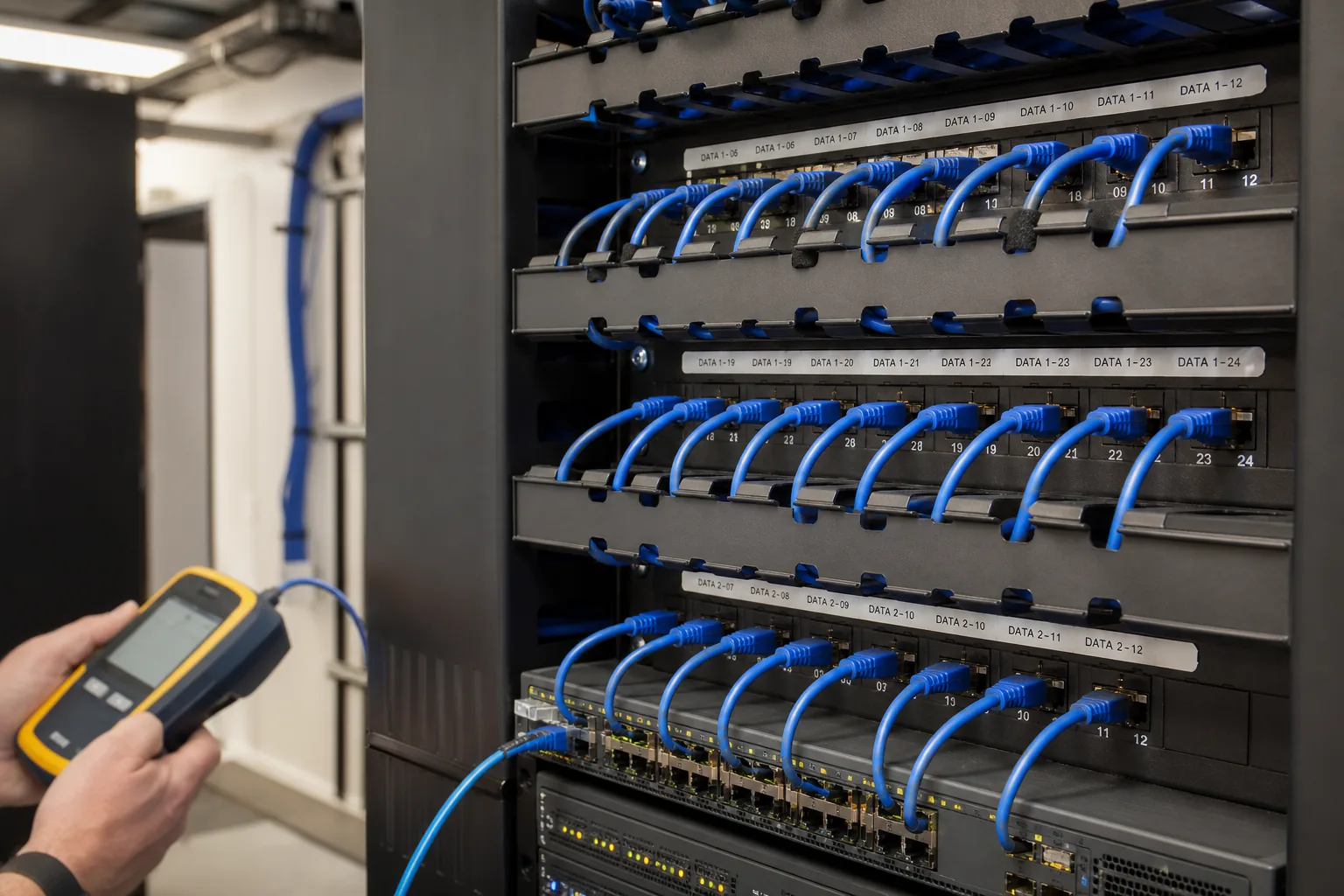
Basic verification can confirm conductor mapping, continuity, length, or obvious faults. Certification evaluates the installed link against a selected cabling performance limit using qualified field-test equipment. The proposal should say which approach applies rather than using the words interchangeably.
Good records are tied to clear cable IDs and endpoints. Test limits, adapters, calibration status, permanent-link or channel configuration, report format, retest rules, and exceptions should be confirmed when certification is required.
- Wiremap and connectivity verification
- Length and fault-location checks when appropriate
- Copper certification when specified
- Fiber loss testing when specified
- Failure identification and retesting
- Electronic results tied to cable labels
Plan the physical layer
Define acceptance before testing begins
A test result is useful only when the expected limit, cabling configuration, label, and required deliverable are understood by the project team.
01
Test requirement
Identify cable type, performance limit, permanent-link or channel method, fiber loss budget, adapters, report format, and specification references.
02
Identification
Match every result to a consistent cable, outlet, panel, and port label so failures and closeout records can be located in the field.
03
Resolution
Document failures, inspect workmanship and components, correct in-scope issues, retest, and clearly list exceptions or excluded existing conditions.
Straightforward project flow
From scope review to tested handoff
A clear cabling project starts with the building conditions and ends with the agreed documentation.
1
Share the project
Send the address, drawings, drop list, photos, schedule, and known site restrictions.
2
Review conditions
We review pathways, distances, network spaces, access, construction phase, and active-service constraints.
3
Define the scope
The proposal identifies included cabling, hardware, assumptions, responsibilities, testing, and closeout.
4
Install and hand off
Work is coordinated, labeled, tested to the agreed requirement, and closed out with defined records.
Common questions
Cable testing questions
Plain answers about scope, materials, testing, and project coordination.
Cable certification uses a qualified field tester to evaluate an installed copper or fiber link against an agreed performance requirement and produce results associated with the cable ID.
No. Continuity or wiremap testing can identify wiring faults, but it does not measure every performance parameter used in a structured cabling certification test.
Yes, when both ends can be accessed and identified. The useful test method depends on the cable type, termination, connected services, existing condition, and reason for testing.
Electronic reports are supplied when they are included in the project scope. The required format, label convention, and acceptance limit should be agreed before work starts.
Need cable testing or project closeout?
Send the cable type, quantities, labels, drawings, test specification, existing conditions, and report format required by the owner or project team.
Commercial data cabling, network wiring, structured copper, fiber, racks, testing, cleanup, and construction cabling for Nashville-area facilities.
[COMPANY_LEGAL_NAME]
[LICENSE]
Site Links
© 2026 Nashville Data Cabling. All rights reserved.
Physical cabling infrastructure. Clear scope. Tested handoff.